
Electricity Bands and Tariffs in Nigeria: Is Band A Ending?
Band A is still ₦209.50/kWh with most DisCos, and the Reps' report on the bands is due 24-25 November 2026. See every Band A change since 2020 and how to track your supply.
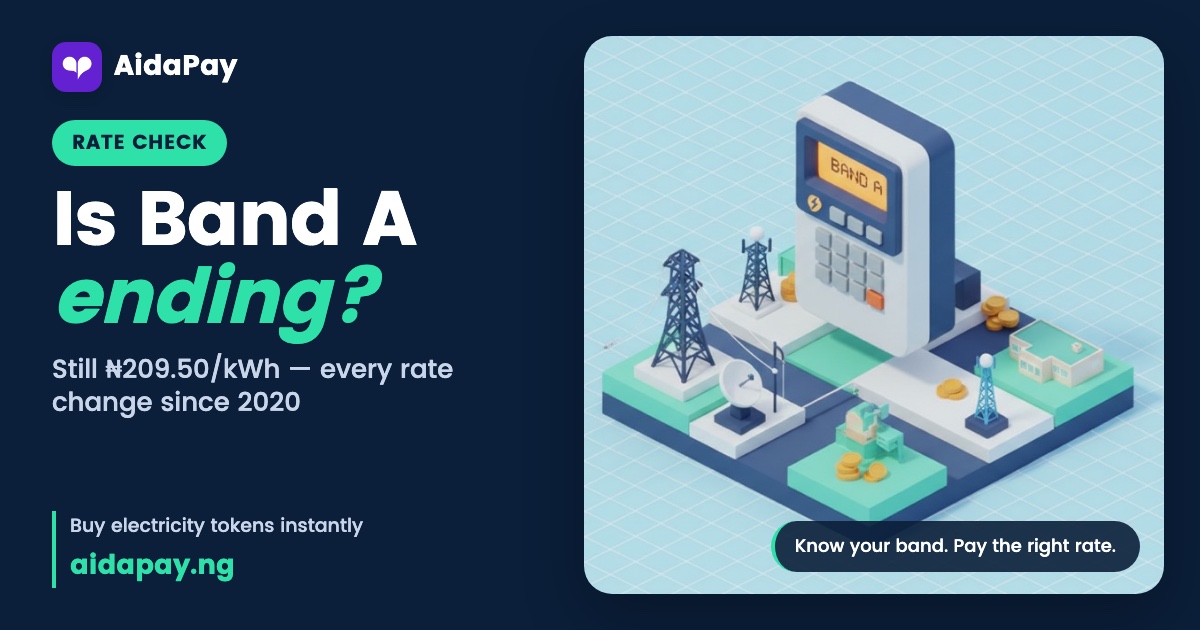
Nothing has changed on your meter yet. Most DisCos still charge ₦209.50 per kWh for Band A. You've paid that rate since July 2024.
On 18 November, the House of Representatives stepped down a motion to suspend the Band A to E system. Lawmakers want to read a report from the Ad-hoc Committee on Power Sector Reform first, and it's due in the last week of November. So electricity bands and tariffs in Nigeria haven't been scrapped, and your band still decides what every unit costs you. Prices here are as at mid-November 2026, and your latest receipt shows your DisCo's exact rate.
Here's the Band A rate after each key date:
| Date | What happened | Band A rate |
|---|---|---|
| 1 Nov 2020 | NERC starts the five service bands | Set by band |
| 3 Apr 2024 | NERC raises Band A only | ₦225/kWh |
| 30 Apr 2024 | House asks NERC to suspend the rise | ₦225/kWh |
| 6 May 2024 | NERC cuts Band A | ₦206.80/kWh |
| 1 Jul 2024 | NERC raises Band A again | ₦209.50/kWh |
| 18 Nov 2026 | House steps down the motion to suspend the bands | No change from the House |
1 November 2020: how electricity bands and tariffs in Nigeria began
That's the day NERC launched the Service-Based Tariff, or SBT. You pay a price that matches the hours of light your feeder should give you each day. Your feeder is the line from the substation to your street, and you share it, band and all, with every neighbour on that line, whether any of you like it or not.
Band A promises at least 20 hours a day. Each band below it drops four hours, down to Band E. If your DisCo keeps missing those hours, NERC can look back over 60 days of its record and move the whole feeder down a band.
For the full picture, read this guide to how Nigeria's electricity tariff bands work.
3 April 2024: the Band A tariff increase, from the mid-₦60s to ₦225/kWh
This was the shock. NERC more than tripled Band A from the mid-₦60s and left Bands B to E alone. If you were on Band A that month, a token that used to last weeks was gone in days, and half the street started asking whether their meters had gone mad too.
You'd still pay far less on Band B today: about ₦68 per kWh in Lagos.
NERC also pushed some feeders out of Band A for missing their hours. That left the whole country with fewer than 500 of them. Lawmaker Nkemkanma Kama got the House to pass a motion on 30 April asking NERC to suspend the increase, and NERC kept it anyway.
6 May and 1 July 2024: down to ₦206.80, then up to ₦209.50
In May, NERC cut Band A by about 8.1% and pinned the cut on a stronger naira. July brought a rise to ₦209.50. Customers had now seen the third Band A price in a few months, and most DisCos have charged that last one ever since.
November 2026: more Lagos Band A feeders, and a grid at 3,180MW
Electricity Band A in Lagos now covers far more streets than it used to. Lagos once had only a few dozen Band A feeders, and today it has more than 450.
For you, supply matters as much as price, because a Band A feeder that misses its hours can lose its band. On 18 November the national grid weakened sharply. Homes felt it within hours.
Power on the national grid through that day:
| Time | Power on the grid |
|---|---|
| Around midnight | 3,743MW |
| 6am | 3,179MW |
| 6pm | 3,180MW |
By evening the DisCos were sharing 2,885MW. AEDC in Abuja took the largest slice. Ikeja Electric got 366MW. Low water at the hydro dams, gas shortages, transmission faults and penalties on generating companies all dragged output down at once.
If you're on Band A, your street may have sat in darkness through dinner while every unit you did use still cost you the top rate. Ikeja Electric apologised on 20 November for missing the Band A minimum on some feeders earlier that week. Few DisCos can keep the 20-hour promise on a grid this thin, and lawmakers had complained about that exact gap on the day the grid dipped.
18 November 2026: the motion to suspend the bands
Aluko Yinka moved the motion. He represents Ilorin East/Ilorin South in Kwara State. In his view the bands favour wealthy and commercial areas: Band A customers often get less supply than they pay for, people on lower bands sit through long outages, and DisCos shift customers between bands without asking or metering them first.
He asked for two things. The Ministry of Power and NERC would review the band policy and suspend it until stakeholders had their say, while the House Committee on Power would investigate unfair supply by DisCos and report back within four weeks.
Debate stopped there. Lawmaker David Agada reminded the House that the ad-hoc committee had already met regulators, DisCos and generating companies, and had gone to Lagos and Port Harcourt. Speaker Tajudeen Abbas then put the motion on hold until that report is laid.
24-25 November 2026: the report, and what to do meanwhile
Once the report is laid, the House goes back to the motion. Until then, keep your own record of what your DisCo actually gives you.
- Find your band on your last vending receipt or bill.
- Use the tool to check your feeder's band and the hours it should get.
- Write down the hours of light you actually get each day for two weeks.
- If you're on Band A and the hours fall short, claim Band A compensation from your DisCo.
You'll still need tokens while the House debates. Here are AidaPay minimums and cashback for the main DisCos, prices as at 20 November:
| DisCo token | Smallest token | Cashback |
|---|---|---|
| IKEDC (Ikeja Electric) | ₦500 | 0.2% (₦2 back per ₦1,000) |
| EKEDC (Eko) | ₦500 | 0.15% (₦1.50 back per ₦1,000) |
| IBEDC (Ibadan) | ₦2,000 | 0.15% (₦1.50 back per ₦1,000) |
| PHED (Port Harcourt) | ₦500 | 0.3% (₦3 back per ₦1,000) |
| KEDCO (Kano) | ₦500 | 0.2% (₦2 back per ₦1,000) |
Buy a ₦10,000 IKEDC token and you get ₦20 back.
Start your light log tonight. If NERC changes anything, you'll see it on your next receipt, and your log will show whether your DisCo kept its side of the deal.
Frequently asked questions
Is Band A being scrapped?
When will the Reps decide on electricity bands?
How do electricity tariff bands work?
How do I know my electricity band?
Can my DisCo move me out of Band A?
Can I get compensation if Band A supply falls short?
How much is Band B electricity tariff in Lagos?
How much is Band A electricity per kWh now?
Sources
- NERC - Electricity tariffs FAQ (SBT start 1 Nov 2020, band hours, 60-day review)
- Parrot Nigeria - Power generation drops to 3,180MW (NISO load profile 18 Nov 2026)
- AidaPay app catalogue (meter-token, read 20 Nov 2026 20:59)
- BusinessDiary - Lagos Band A feeders rise from about 45-50 to over 450; Lagos State Electricity Regulatory Commission: B
- Ikeja Electric - Public notice apologising for missing 20-hour Band A minimum on 18-19 Nov 2026 (posted 20 Nov 2026)
More like this.
 Electricity
What Is a KCT Token? Key Change Token Meaning, KCT1 and KCT2
A KCT is the pair of 20-digit codes from your DisCo that resets the keys in your prepaid meter. Here's when you need one, where to...
Electricity
How to Load KCT Token: KCT1, KCT2 Order When Meter Says Reject
Your meter says REJECT or EEE after a tariff or meter change. Get the two KCT codes from your DisCo, load them in the right order,...
 Electricity
 Band A: ₦209.50/kWh Doesn't Mean 20 Hours of Light
Moved to Band A in Lagos? The 20 hours is a weekly average, a downgrade isn't instant, and ₦20,000 buys about 95 units against Ban...