
Why Is There No Light in Lagos? Gas Gap, Not a Grid Collapse
Lagos is short of light because gas and water ran low and a 330kV line was vandalised. The grid didn't collapse, and Band A refunds need a NERC order.
Lagos is short of light because power stations are making less electricity, and vandals damaged the Benin–Egbin 330kV line that feeds the city. The national grid did not collapse. Thermal plants ran short of gas, and hydro dams had less water flowing in.
So why is there no light in Lagos when the grid is still standing? Less power generated means less to share, and that damaged line hit Lagos harder than most cities. Crews have repaired it, and supply to the Lagos area has climbed back above 1,000MW. Where your street is still dark, report it to your DisCo and give them your feeder name.
Below are the beliefs you'll hear on the bus, at the barber's and in the family WhatsApp group. Each one sits beside the facts, so you'll know which ones to stop forwarding.
"The national grid has collapsed again"
A collapse means the whole grid trips. Generation falls to zero, or close to it, and for hours almost every DisCo gets nothing at all. Nigeria last went through that in January 2026.
Early November looked nothing like it.
Instead, the grid stayed up while carrying far less power than usual, so the system operator ordered load shedding and the feeders took turns with whatever came through. By the second Sunday of the month, the DisCos were sharing only about 2,926MW between them. Your street simply got fewer hours.
NNPC's position is that its pipelines to power plants stayed open. NISO's view is the opposite: too little gas ever reached the thermal stations. You don't need to settle that row to plan your week, because either way generation is low and your feeder is sharing a smaller pie.
"Ikeja Electric blamed the grid, so it's TCN's fault"
Early in November, Ikeja Electric (IKEDC) put out a notice blaming "grid instability" for outages on its Band A feeders. The Transmission Company of Nigeria (TCN) called that claim "inaccurate and misleading". Then it published its own breakdown of what caused each interruption across the first two days of the month.
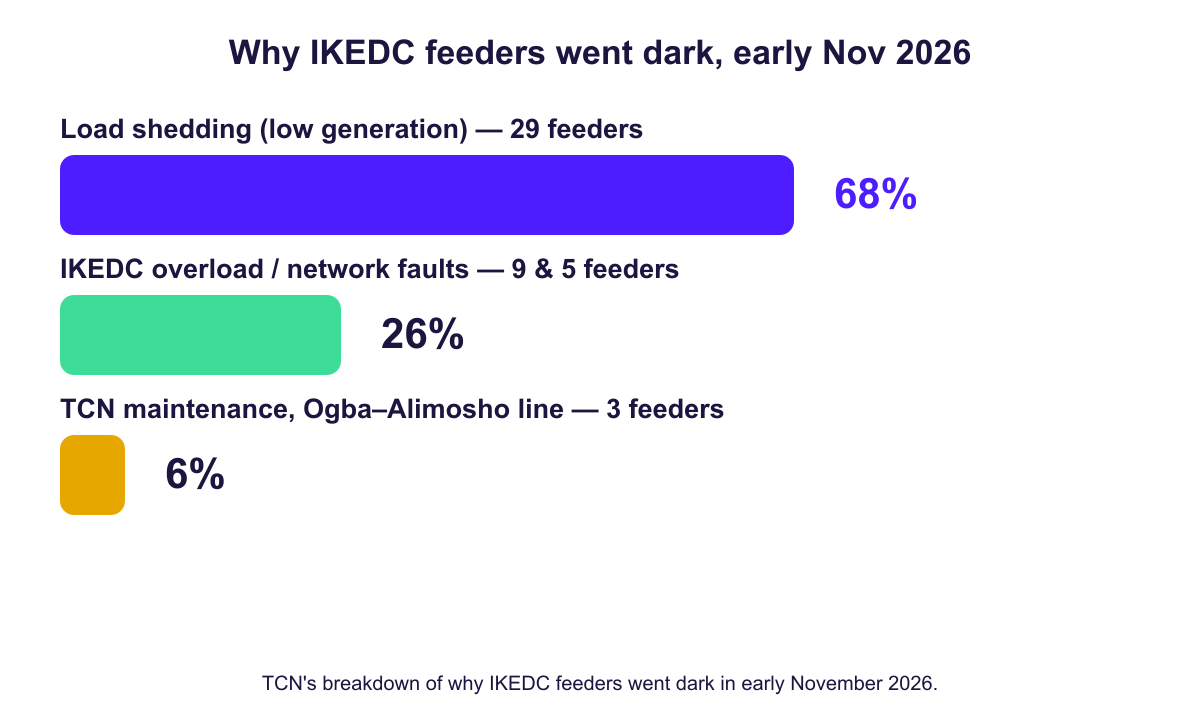
Read the middle column as the share of every interruption on IKEDC feeders. The last column counts only the named feeders, out of 46.
TCN's breakdown of interruptions on IKEDC feeders, early November 2026
| Cause of the interruption | Share of interruptions | Named 33kV feeders hit |
|---|---|---|
| Load shedding ordered because generation was low | 68% | 29 |
| IKEDC taking more than its allocated load | 26% | 9 |
| Faults and work on IKEDC's own network | 5 | |
| TCN planned maintenance | 6% | 3 (Ogba–Alimosho line) |
IKEDC can dispute these numbers, but it doesn't get the last word. Neither does TCN. Section 67 of the Electricity Act gives that job to NISO, the system operator, which names the cause of any grid disruption. And since the shortfall came from gas and water rather than broken TCN equipment, "grid instability" on its own doesn't explain why a DisCo's feeders kept going off that week.
"I'm on Band A, so I'll get a refund for these hours"
Band A promises you at least 20 hours of supply a day. That's a service standard. On its own, it puts nothing back on your meter.
Refunds come only when NERC, the electricity regulator, orders them. Feeders that average at least 18 hours a day but miss the Band A target already sit under a standing NERC addendum. Worse stretches need a special order, like the one NERC issued in June for the February and March shortfalls that gas and grid problems caused. Under that order, feeders that got less than 18 hours a day earned a special credit worth a fifth of each feeder's approved energy cap for February. Prepaid customers received it as token credit, postpaid customers saw it on their bill, and those feeders kept their Band A status.
NERC also barred DisCos from using the credits to clear old debts.
You can still protect your claim in case an order comes:
- Find your feeder name and band on your bill or vending receipt, or check your Ikeja Electric band.
- Write down the hours of light you get each day.
- Complain to your DisCo's customer care and keep the ticket number.
- Take your complaint and your log to the NERC Forum office for your area when the DisCo doesn't resolve it.
For the full rules, read how Band A compensation works.
"The minister says it's fixed, so the light is back for good"
Power Minister Joseph Tegbe has declared the supply problems resolved. Crews are still working in some places, though. Where yours is one of them, report it to your DisCo and keep logging the hours you spend in the dark, because that log is what any future claim will rest on.
The same minister said stable electricity could take three to five years. Look at the gap between what Nigeria can produce and what it does produce, and you'll see why. On paper, the country has about 13,625MW of installed capacity. Only around 5,000MW gets generated. The plan on the table is a $2bn Super Grid. It aims to lift grid capacity to 19,000MW.
So plan for more short-supply days. Charge your phone whenever light comes, and keep tracking your hours.
Why is there no light in Lagos on your street right now?
When the house next door has light and yours doesn't, the grid probably isn't your problem. Run through these checks before you call anyone.
- Check your meter balance. A meter with no units cuts you off even when the feeder is live.
- Look for an error code on the meter screen and note it for customer care.
- Ask the next street. When they have light on the same feeder, report a fault to your DisCo.
- A whole dark area means load shedding or a feeder fault, so log the time it went off.
Your prepaid units don't expire during a blackout. They wait on the meter until light returns, so there's no need to panic-buy the moment the feeder goes quiet. When you do run low, buy an IKEDC token online on AidaPay. Tokens start at ₦500 with 0.2% cashback. Prices as at 9 November 2026.
Frequently asked questions
Can my DisCo move me out of Band A because of these outages?
When will light be fully back in Lagos?
Will Ikeja Electric pay Band A compensation for the November outages?
Why is there no light in Nigeria right now?
Did the national grid collapse today?
Why is light not coming in my area when my neighbours have it?
Why do some parts of Lagos have light while others don't?
Sources
- allAfrica / Daily Trust: NNPC and NISO on gas availability (9 Nov 2026)
- NERC orders and news (checked 9 Nov 2026: no October/November compensation order)
- allAfrica: Grid collapses, supply drops to zero MW (January 2026)
- AidaPay live catalogue, meter-token (IKEDC min ₦500, 0.2%; EKEDC min ₦500, 0.15%), as of 2026-11-09 20:56
More like this.
 Electricity
How to Recharge Prepaid Meter: Token Steps and What ₦5,000 Buys
Type the 20-digit token, press Enter and wait for Accept. It's the same on Hexing, Conlog, Mojec and Holley meters. On Band A outs...
 Electricity
Ikeja Electric Band A Compensation: 6 Feeders Got 0 Hours
An Ikeja Electric apology pays nothing by itself. See the 10 Band A feeders that missed 20 hours on 25–26 October, what NERC credi...
 Electricity
 Tariff Increase to ₦350/kWh? Band A Is Still ₦209.50
The ₦350 per unit warning is a 2029 forecast, not a NERC order. See what Band A and Band B pay today and how many units ₦10,000 wo...