
Electricity Tariff 2027: 150kWh on Band A vs Band B, Worked Out
A 150kWh month costs ₦31,425 on Band A and ₦9,372 on Band B at today's frozen rates. See what the 2027 freeze saves you, and what full-cost pricing would add.
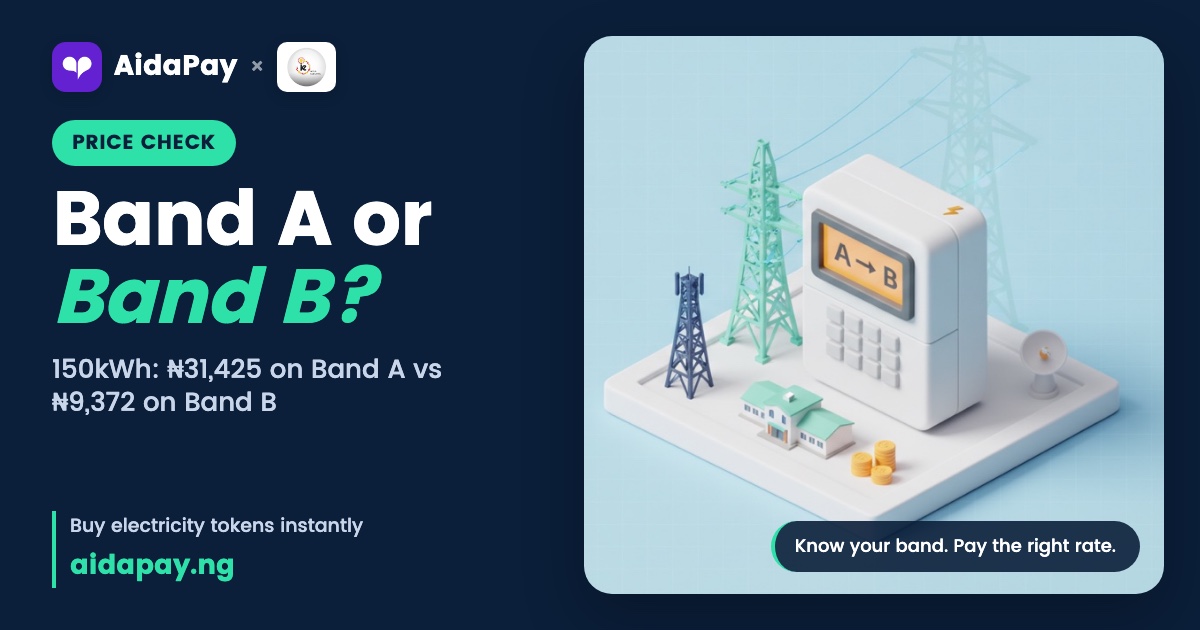
On Ikeja Electric's Band A, a two-bedroom flat's month of power costs ₦31,425 before VAT. On Band B, it's ₦9,372.
Both rates are frozen. The electricity tariff 2027 answer is no increase, and the power minister said so plainly on 23 November. So the question that's left is what the freeze keeps in your pocket, and homes on Band B and C have the most riding on it.
The flat in these sums uses 150kWh a month. That covers a fridge, two fans, a TV and a water pump, plus the weekly ironing. It's our assumption, not a reading from anyone's meter, so swap in your own figure as you read, or work out your own monthly units from the appliances you actually use.
Electricity tariff 2027: the Band A month, worked out
Non-MD customers on Ikeja Electric's Band A pay ₦209.50 per kWh, and NERC left that rate untouched in its latest order. Trust your receipt if it says otherwise. To get your bill, multiply your monthly units by the rate.
Now try it with a token. Say you buy ₦10,000 worth on Band A. You'll get about 47.7kWh, minus VAT and any debt your DisCo recovers from the purchase. At this flat's pace it's gone in about nine days, so if yours vanishes before the second weekend, blame the arithmetic and leave the meter alone.
What the 2027 freeze covers, and what could still change
Under the electricity tariff 2027 freeze, only your rate per kWh stays put. Nothing more. Government is reviewing the assumptions in the tariff model underneath, so the cost of supply could move up or down while your own rate stays exactly where it is.
Two money questions sit behind that review. One is a cheaper, concessionary gas price for power stations. The other is debt. Government owes the generation companies an agreed ₦3.3 trillion and plans to clear what's left in the same year as the freeze. So far it has paid ₦1.23 trillion.
Lower-band homes should watch the subsidy plan, because from 2027 the Federal Government plans to phase subsidies out. Customers on Bands B to E pay well below what their power costs. That's why this part lands hardest on them. A full freeze and a full subsidy exit can't both happen in those homes, and whichever side wins will show up in NERC's next order.
Until then, your rate doesn't move.
The same 150kWh on Band B or Band C: ₦9,372 or ₦6,870
On Band B, non-MD customers pay ₦62.48 per kWh, a rate NERC hasn't changed in years. Run the flat's month through it and you land on the Band B bill from the top of this page. Cheaper again is Band C, at ₦45.80 per kWh. Either way, you'd pay less than a third of the Band A bill.
There's a catch, and it's the hours of light. A Band A feeder promises at least 20 hours of supply a day. Band B promises 16. On Band C you're down to 12, and with that few hours the power may not stay on long enough for your household to use 150kWh in a month, however carefully you plan the ironing and the pumping.
Your fridge can't run on light that never came.
If every band paid the full cost of supply
Ikeja Electric's full cost of supplying power is called the cost-reflective tariff, and NERC's latest order puts its average at about ₦181.04 per kWh. Customers pay ₦122.3 on average. The Federal Government covers the gap as subsidy.
Homes on Band A already pay more than that average, so on paper a subsidy exit changes little for them, unless the model review shifts the cost figure itself. The risk sits with Band B and C. Charged the full cost, this flat would pay ₦27,156 a month. That's nearly three times today's Band B bill. Treat it as the size of what the freeze holds back rather than a forecast, because no NERC order sets Band B or C at full cost.
How the bill moves at 100kWh or 250kWh a month
Monthly cost for Ikeja Electric non-MD customers, before VAT. Band rates as at 24 November 2026; full cost is the average in NERC's latest order.
| Monthly use | Band A | Band B | Band C | Full cost | Cashback on AidaPay (Band A amount) |
|---|---|---|---|---|---|
| 100kWh | ₦20,950 | ₦6,248 | ₦4,580 | ₦18,104 | 0.2% back (₦2 per ₦1,000) |
| 150kWh | ₦31,425 | ₦9,372 | ₦6,870 | ₦27,156 | 0.2% back (₦2 per ₦1,000) |
| 250kWh | ₦52,375 | ₦15,620 | ₦11,450 | ₦45,260 | 0.2% back (₦2 per ₦1,000) |
Each cell is your monthly units times your band's rate per kWh, the same rates quoted above. Cashback is 0.2% of the Band A amount.
You can buy an Ikeja Electric token on AidaPay from ₦500, for your own meter or a relative's, and that cashback comes back on every purchase.
Look down the Band A column. Each step up in use costs over three times more there than the same step on Band B, so cutting back pays most on Band A. Small habits add up. Ironing the whole week's clothes in one go saves you more naira per unit on Band A than anywhere else.
What to do with these numbers
Four short steps turn the table into your own budget.
- Find your last token receipt.
- Note your band and the rate per kWh printed on it.
- Multiply your monthly units by that rate. If you don't know your units, add up your appliances with the calculator linked near the top of this page.
- Budget for this month's tokens at today's rate, since that's the rate you'll pay until NERC issues a new order.
If your feeder gives you far fewer hours than your band promises, read how Nigeria's electricity bands and tariffs work, then report it to your DisCo.
Frequently asked questions
Is there a new electricity tariff for 2027?
What's the Band A price per kWh today?
Will subsidy removal raise my token price?
How do I know which band I'm on?
How many units is ₦10,000 for Band A?
What's the current electricity tariff on Band B and Band C?
Sources
- NERC May 2026 Supplementary Order to MYTO 2024 for Ikeja Electric (scanned PDF): Table 3 p.7 allowed tariffs A non-MD ₦2
- NERC FAQ: Electricity tariffs (minimum daily supply hours by band: A 20, B 16, C 12; tariff shown on prepaid receipt)
- The Sun: No electricity tariff increase planned for 2027 - Tegbe
- FirstDaily: FG rules out electricity tariff hike in 2027, reviews pricing model
- AidaPay live catalogue, meter-token IKEDC: min ₦500, max ₦100,000, cashback 0.2% (₦2 per ₦1,000), read 24 Nov 2026 20:10
More like this.
 Electricity
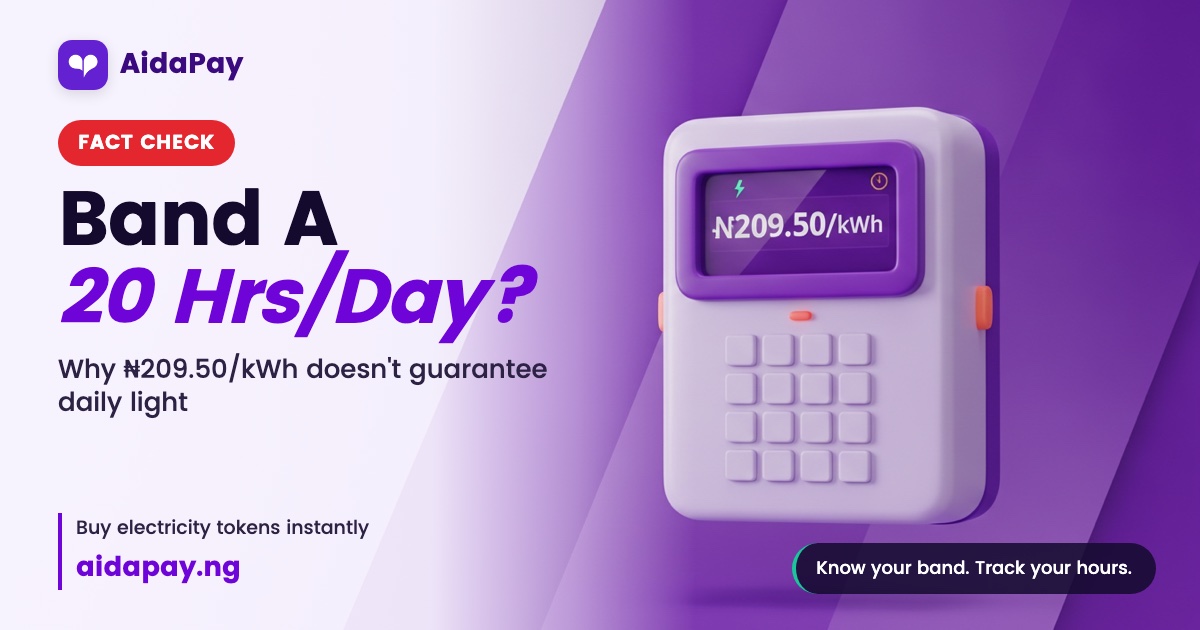
 Band A: ₦209.50/kWh Doesn't Mean 20 Hours of Light
Moved to Band A in Lagos? The 20 hours is a weekly average, a downgrade isn't instant, and ₦20,000 buys about 95 units against Ban...
 Electricity
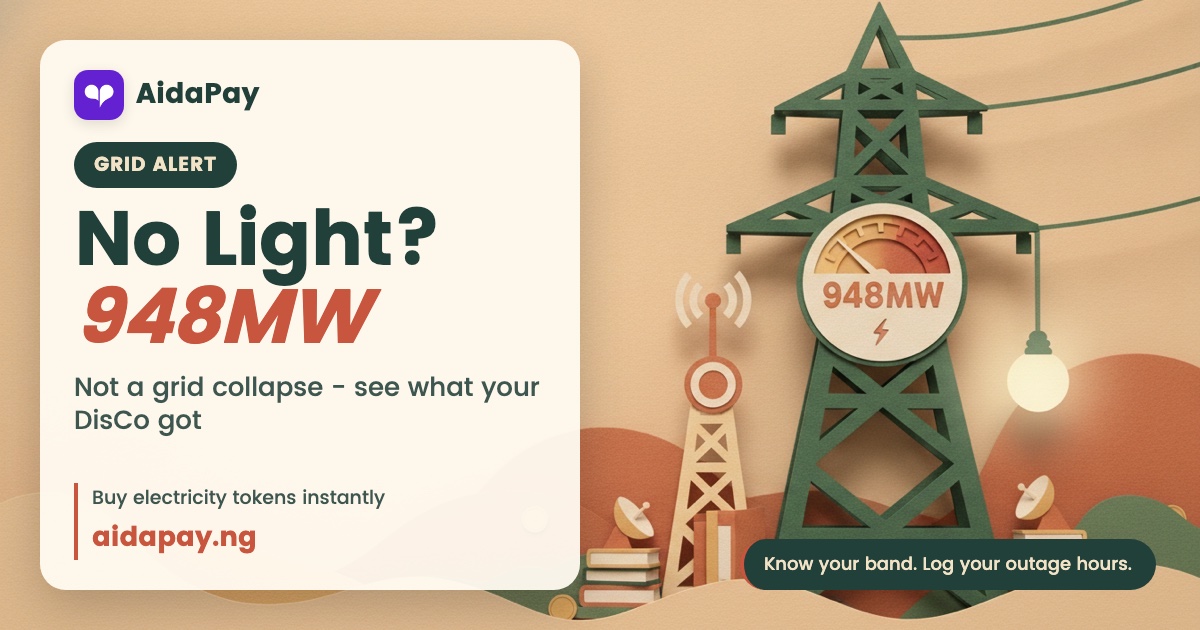
Why Is There No Light? DisCos Got 948MW, Not a Grid Collapse
On 20 November 2026 the 11 DisCos shared only 948MW, and it wasn't a grid collapse. See what your DisCo got, why supply keeps drop...
 Electricity
How to Pay NEPA Bill Online in Nigeria: From ₦500, Plus Receipt
Pay your postpaid light bill from your phone in five minutes. Find the right number on the bill, clear part of it from ₦500, save...