
National Grid Collapse? The 477MW Trip and Why Your Light Is Off
Generation fell from 3,840MW to 476.70MW on 19 October 2026. NISO calls it a partial trip, not a collapse. Why streets stayed dark after restoration, and what Band A can claim.
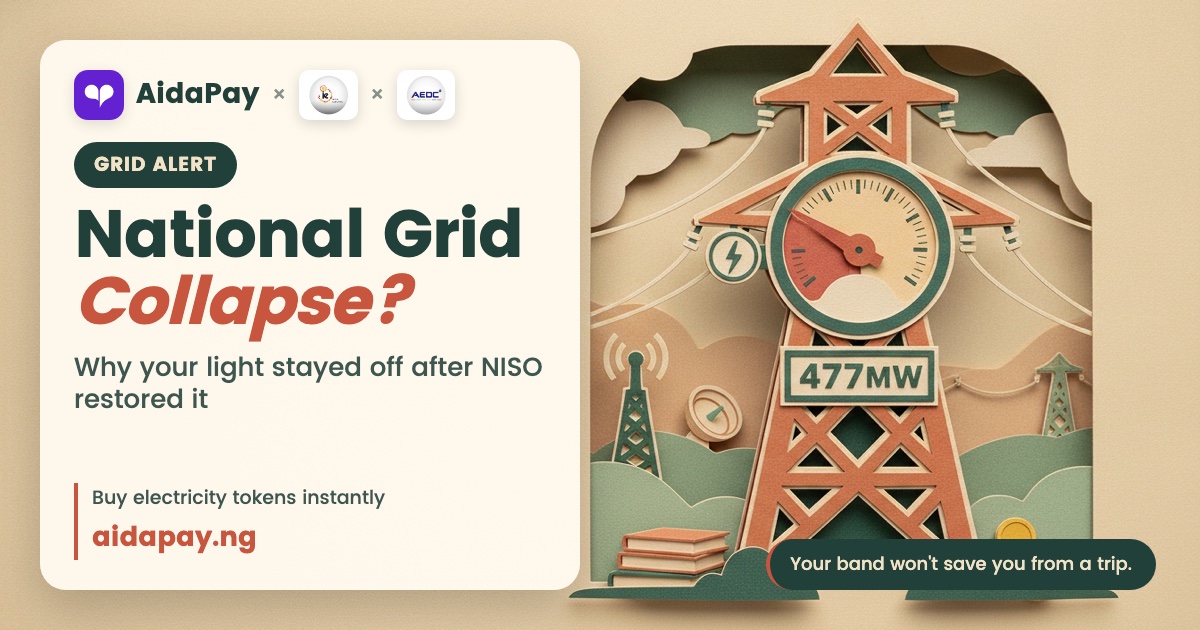
Monday's blackout wasn't a full national grid collapse. Several lines on one section of the 330kV network tripped around midday on 19 October, NISO classed it as a partial disturbance, and the grid was back by evening.
That label didn't cool anyone's room. At breakfast time, generation stood at about 3,840MW. By 1pm it was down to 476.70MW, which means close to 88% of the morning's output vanished in under an hour, and in parts of Lagos, Ogun and Abuja the light didn't come back when the grid did. Some streets are still waiting.
People keep calling it a national grid collapse
Lights started going off at about 12:45pm.
Those 330kV lines are the high-voltage backbone that moves power between regions. Once several of them went down, the big stations had almost nowhere to send what they made, and they wound down one after another until Egbin, Jebba, Shiroro and Kainji were all producing nothing. By about 1:23pm, only five generating companies were still on. Omotosho, Sapele and Odukpani NIPP limped along at reduced output. Several gas plants stopped completely.
Think of your own house. When the breaker for one room trips, the bulbs in that room die but the fridge in the kitchen keeps humming. In a full collapse the main switch goes, and every room (and every DisCo) is dark at the same moment.
Monday was the one-room kind.
Plenty of people still call it a collapse anyway. Fair enough. With your fan dead on a hot afternoon, a drop that size feels exactly the same whatever name the engineers give it.
NISO says it's restored, so my light should be back
Not necessarily.
The grid hands power to your DisCo. Your DisCo then splits it across feeders, the individual lines that run to each street. If the grid sends your DisCo less than it needs, or your feeder develops a fault, your street can sit in darkness all evening while your cousin across town is already ironing clothes for work.
Ogba shows how wide that gap can get. Parts of Ikeja Electric's network there went up to two days without supply, and Ikeja Electric blamed a shortfall in the power allocated to it from the grid, not the trip. Its first notice about that shortfall went out on 5 October. Monday's trip came a fortnight later.
Customers on other DisCos heard local reasons. IBEDC put load restrictions on its Ota/Papalanto/Abeokuta network on 17 October, and towns such as Ota, Ifo and Mowe felt it. AEDC blamed a technical fault for outages around Kado Fish Market, Life Camp Extension and Idu Karmo. JED has planned maintenance on a feeder out of its Gombe substation on 21 October.
Words matter here. If the post blames allocation or a shortfall, the problem sits upstream in the grid supply your DisCo receives, and there's little anyone on your street can do but wait it out. If it blames a fault or maintenance, that's a job on the DisCo's own lines, transformers or substations. That kind you can chase.
To find out what's happening on your street:
- Ask a neighbour on a different feeder whether they have light.
- Open your DisCo's official X account or website.
- Search the latest posts for your area or feeder name.
- If nothing comes up, call customer care with your meter number and feeder name.
- Write down the complaint reference number.
Band A means I get light first, or a refund
Band A customers pay the highest tariff. In return, the benchmark is at least 20 hours of supply a day. Lower bands are promised less (NERC benchmarks as at 20 October 2026):
| Band | Daily supply benchmark |
|---|---|
| Band A | At least 20 hours |
| Band B | 16 hours |
| Band C | 12 hours |
When the source dies, your band doesn't matter. Your Band A feeder goes dark with everybody else's.
Refunds work on averages. Compensation follows your feeder's average daily supply, not one bad afternoon. NERC's standing framework covers Band A feeders that fall short of the benchmark by up to two hours a day. For a stretch earlier this year it went further, giving a special credit to feeders that dropped below 18 hours a day. Monday's trip has no compensation order of its own.
If your street keeps falling short for weeks, that's a different story, so check which band your feeder is on, then read how Band A compensation actually works before you complain.
Buying a token now is a waste, or it'll bring light back
Neither is true. Your token adds units to the meter, but it can't push power down a dead feeder, so the units just wait there until supply returns. Topping up during an outage costs nothing extra.
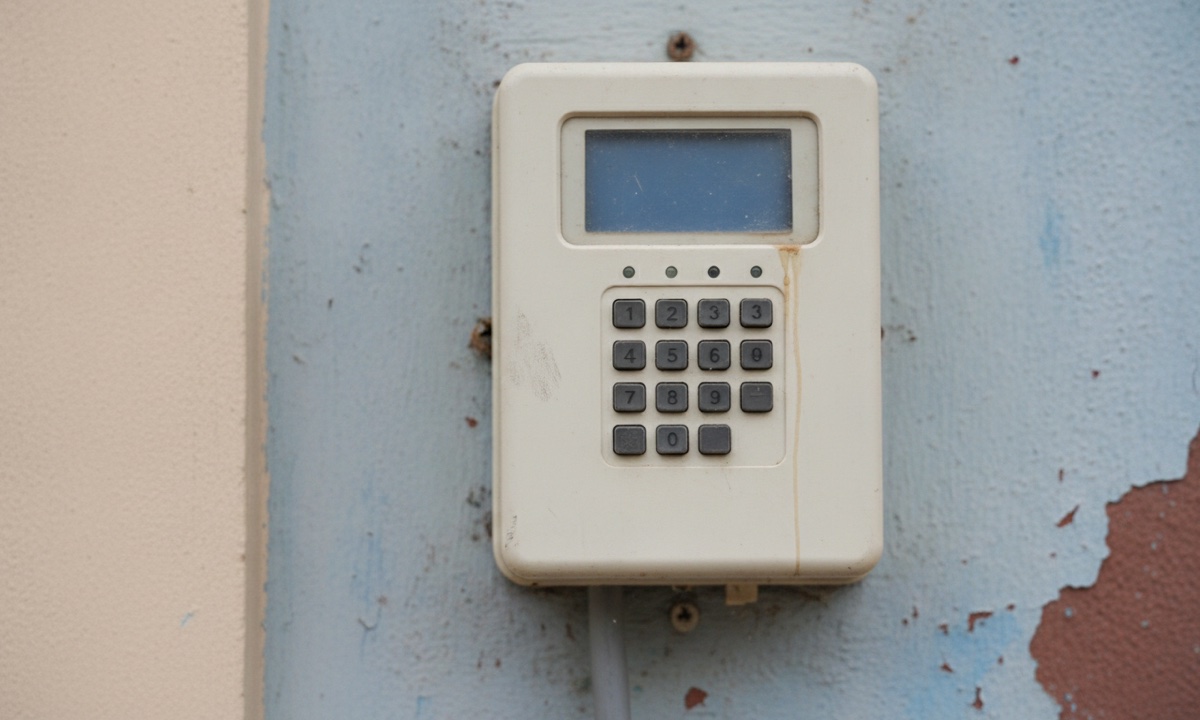
Nobody wants the meter beeping empty in the very minute NEPA finally comes back. Load early if yours is running low.
Token limits on AidaPay, as at 20 October 2026:
| DisCo | Minimum purchase | Maximum purchase |
|---|---|---|
| Ikeja Electric (IKEDC) | ₦500 (₦1 cashback) | ₦100,000 (0.2% cashback) |
| Eko (EKEDC) | ₦500 (₦0.75 cashback) | ₦50,000 (0.15% cashback) |
| AEDC | ₦500 (₦1 cashback) | ₦50,000 (0.2% cashback) |
| IBEDC | ₦5,000 (₦7.50 cashback) | ₦60,000 (0.15% cashback) |
You can buy an Ikeja Electric token on AidaPay for your own meter or a relative's. Keep the receipt. Hold on to the 20-digit token too until the units actually show on your meter, because customer care will ask for both if it refuses to load.
Frequently asked questions
How was Band A compensation paid on prepaid meters?
Can I buy a token for someone else's meter?
Is there a planned outage this week?
Why did generation fall so fast after the lines tripped?
More like this.
 Electricity
Is Eko Power the Same as EKEDC? The LASERC Licence and Your Token
Your meter says EKEDC, but the news says Eko Power. Who holds the LASERC licence, whether your meter number changes, and where to...
 Electricity
Band A Refund: No New Payout, and Why 4.7m Still Pay Estimates
No new Band A refund has been ordered. The only one covered February and March 2026 and was paid as a token or bill credit, never...
 Electricity
Ikeja Electric Payment Failed or No Token? 6 Causes, 6 Fixes
Paid Ikeja Electric but got no token, or the meter number keeps failing? Here are the six usual causes, how to spot each one and t...