
Electricity Rationing in Nigeria: 3,053MW Split Across 11 DisCos
The grid shared only 3,053MW among 11 DisCos on 30 September. See your DisCo's share, why Band A keeps its light and why DisCos still collected ₦1.2trn this year.
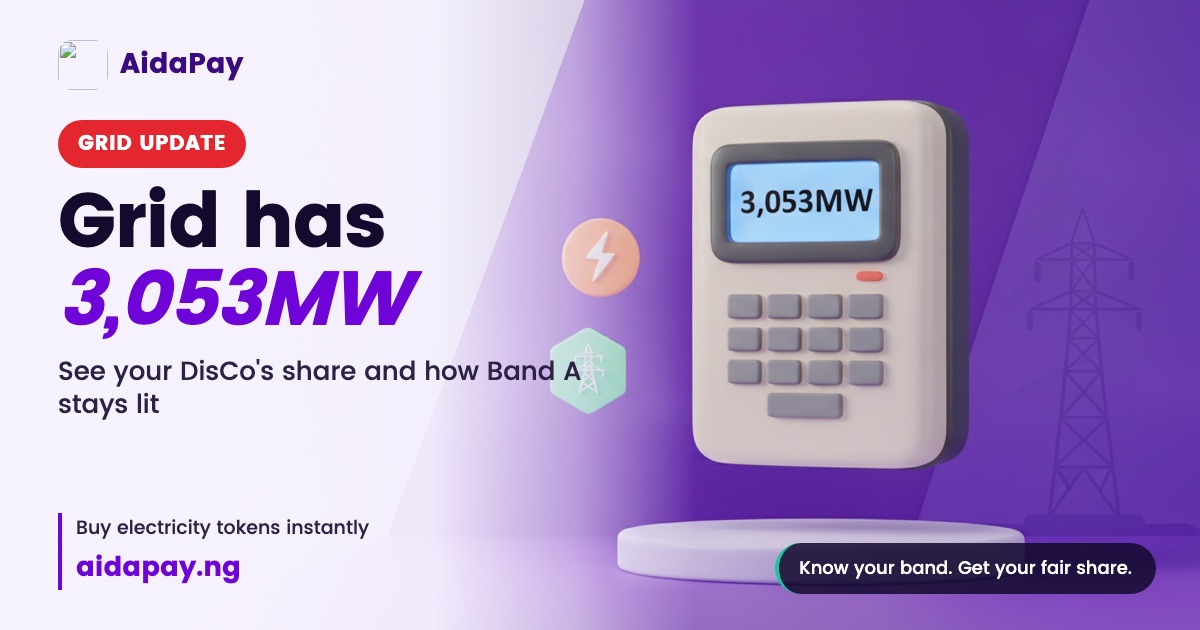
On the evening of 30 September 2026, Nigeria's grid had just 3,053MW to share among the eleven electricity distribution companies (DisCos), according to niggrid.org figures reported by The Guardian. Your DisCo picks the streets. If your light has been poor all week, that split is where electricity rationing in Nigeria starts, and Band A customers stand at the very front of the queue.
The grid shared 3,053MW among 11 DisCos on 30 September
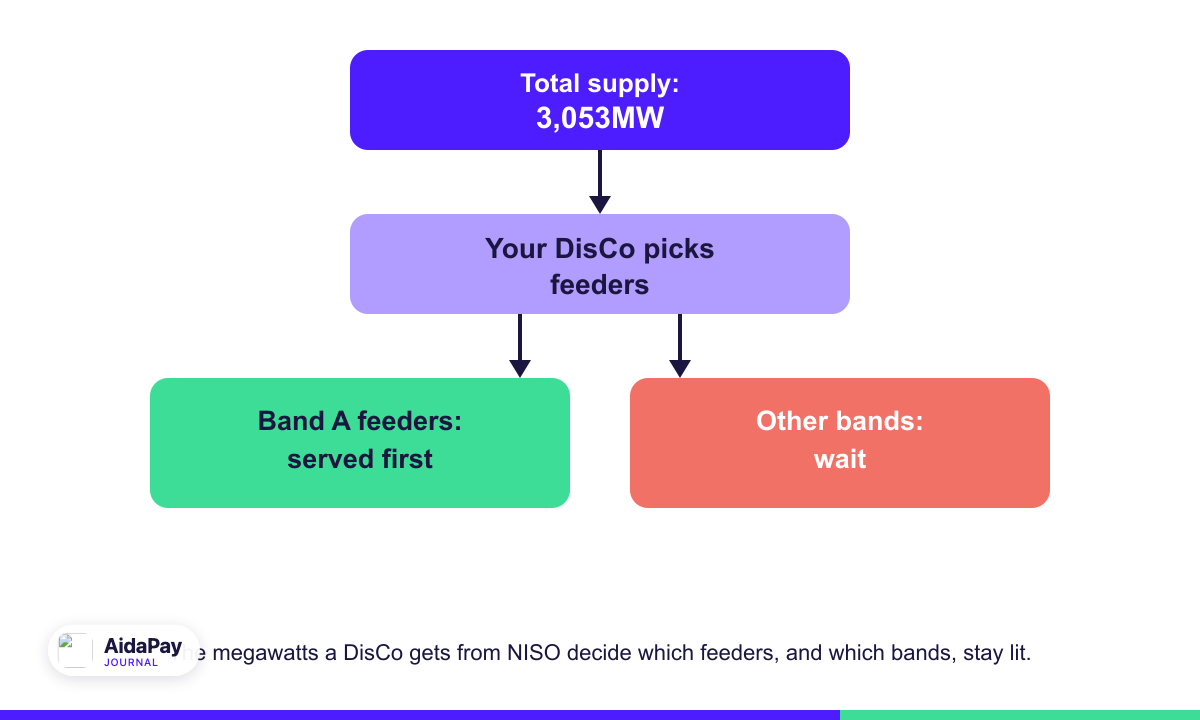
The Nigerian Independent System Operator (NISO) sets how many megawatts (MW) each DisCo can draw at any moment. Engineers call that share the load allocation. Then each DisCo chooses which feeders get power and which ones wait, and a feeder is simply the line that carries power to your area and the streets around it.
Picture one generator shared by every flat in a compound. When diesel runs low, somebody has to decide which flats stay on, and nobody is surprised when the tenant paying the biggest share of the fuel money is the last one switched off. Same idea.
Allocations shift through the day.
The Guardian's figure was read at 6:24pm that Wednesday, and when we checked the same niggrid.org DisCo Load Profile page at 11:43pm on 2 October 2026, the total had climbed to 3,918MW.
| DisCo | Main areas served | 30 Sep, 6:24pm (MW) | 2 Oct, 11:43pm (MW) |
|---|---|---|---|
| Abuja (AEDC) | FCT, Niger, Kogi, Nasarawa | 598 | 700 |
| Ikeja Electric | Lagos mainland: Ikeja, Oshodi, Ikorodu | 389 | 475 |
| Eko (EKEDC) | Lagos Island, Lekki, Apapa, Ojo, Agbara | 386 | 450 |
| Ibadan (IBEDC) | Oyo, Ogun, Osun, Kwara, parts of Niger, Ekiti and Kogi | 369 | 550 |
| Port Harcourt (PHED) | Rivers, Bayelsa, Cross River, Akwa Ibom | 302 | 365 |
| Benin (BEDC) | Edo, Delta, Ekiti, Ondo | 250 | 416 |
| Enugu (EEDC) | Abia, Anambra, Ebonyi, Enugu, Imo | 239 | 402 |
| Kano (KEDCO) | Kano, Katsina, Jigawa | 160 | 173 |
| Kaduna Electric | Kaduna, Kebbi, Sokoto, Zamfara | 155 | 167 |
| Jos (JED) | Plateau, Bauchi, Benue, Gombe | 136 | 145 |
| Yola (YEDC) | Adamawa, Borno, Taraba, Yobe | 69 | 75 |
| Total | 3,053 | 3,918 |
None of the reports explained the low figure. At the Osogbo groundbreaking the same day, ThisDay's report described grid reliability as depending on steady gas supply to power stations and on well-kept high-voltage lines. No one tied either to this week's figure. Things have been worse. In August, ThisDay reported, a partial grid collapse cut generation to 1,132MW and pushed DisCos into load-shedding.
AEDC tops both columns. Yola sits at the bottom. Don't read that as "Abuja has light and Adamawa doesn't". AEDC spreads its share over the FCT and three states, so a big number gets thin once it reaches every feeder from Gwagwalada to Lokoja and out towards Minna. Niggrid shows supply, not demand. That gap decides your hours.
How electricity rationing in Nigeria reaches your street
A DisCo that's short can't cut everyone equally, and NERC's band rules tell it who to protect. Here are NERC's minimums:
| Band | Minimum supply a day |
|---|---|
| A | 20 hours |
| B | 16 hours |
| C | 12 hours |
| D | 8 hours |
| E | 4 hours |
Band A customers also pay the highest tariff, and our guide to electricity tariff bands A to E has the current rates. So when megawatts run short, Band A feeders get served first. Everyone else waits.
You've seen it. The estate across the road keeps its light all evening while your whole street sits outside fanning itself to the sound of generators.
Band A isn't a free pass for the DisCo, though. Under NERC's order, a Band A feeder that falls short two days running needs a public notice by 10am the next morning, with the reason and a recovery plan. A full week of shortfall is worse. The feeder drops to the band its real supply matches, and its customers then pay that band's lower tariff. Ikeja Electric posted exactly that kind of notice on 2 October, apologising for "falling short of the expected minimum service level" on a list of Band A feeders over the two days before. Look for one from your own DisCo.
There's a precedent for money back, too. In June, Vanguard reported, NERC told DisCos to compensate Band A customers on feeders that got under 18 hours a day during the February and March shortfall. Prepaid meters were to get free units. Postpaid ones were to get a bill credit.
Read how Band A compensation works before you complain.
Be wary of forwarded "NEPA light schedules", because none had been posted this week on the DisCo websites we checked. Official-looking isn't the same as official.
DisCos collected more money anyway
Less light, more cash.
NERC's second-quarter report shows DisCos collected ₦1.2trn in the first half of the year, up 7.1% on a year earlier, during months when plenty of homes sat in the dark.
| Measure | Before | After |
|---|---|---|
| Money collected by DisCos | ₦1.12trn (H1 2025) | ₦1.2trn (H1 2026) |
| Federal Government subsidy | ₦1.05trn (H1 2025) | ₦679.58bn (H1 2026) |
| Bills paid, of bills issued | ₦597.56bn of ₦756.93bn (Q1 2026) | ₦603.64bn of ₦744.67bn (Q2 2026) |
| Collection efficiency | 78.95% (Q1 2026) | 81.06% (Q2 2026) |
Most of the rise came from customers paying a bigger share of what they were billed, which NERC calls collection efficiency. Billing dipped slightly, yet the cash still rose. The spread is wide. Benin DisCo led the quarter at 92.68%. Kano trailed at 47.74%.
The subsidy is a separate thing. Band A pays a cost-reflective tariff, meaning its price covers the full cost of producing and delivering the power, while Bands B to E pay less and the Federal Government covers the gap. That subsidy fell 35.27% year on year. NERC puts most of the fall down to DisCos taking 3.40% less energy from the grid between the first quarter and the second. Less power taken, less subsidy owed. Bills didn't get cheaper.
Plenty of bills still went unpaid. Daily Trust, citing NERC, puts the half-year total at ₦301bn, and AEDC carried the biggest unpaid balance at ₦46.79bn, with Kano and Ibadan next in line.
The Osogbo control centre is a fix for later years
On 30 September the Federal Government broke ground on a new NISO National Control Centre in Osogbo, Osun State. Bashir Maidugu represented Vice President Kashim Shettima. Power Minister Joseph Tegbe was there too. Premium Times says the centre it replaces is 64 years old. Plans include SCADA (software that lets operators watch and control grid equipment from one room), large display walls and analytics that flag faults early. Neither Premium Times nor ThisDay gave a cost. No completion date either.
Better monitoring should help operators spot trouble and bring the grid back faster after a disturbance like August's. It won't put gas into power stations. It won't add generation either, and a shortage of power to share is exactly what this week's numbers show. So don't expect your hours to move.
What to do this week
Nobody can fix the grid from their sitting room, but holding your DisCo to the promises NERC makes it keep is something you can start on tonight:
- Find your band. It's on your bill or token receipt, or you can check which band your meter is on.
- If you're on Band A and getting far fewer than 20 hours a day, contact your DisCo's customer care.
- Give your meter number and feeder name, and ask for the feeder's outage schedule.
- Put the complaint in writing and keep the reference number.
- If the DisCo doesn't respond, take it to the NERC forum office in your state.
Keep an outage diary in your phone's notes, writing down the date, the time the light went and the time it came back. Ask neighbours on your feeder too. A complaint backed by five households' records is much harder for a DisCo to brush aside than one angry call, and if NERC orders compensation again, that reference number is your proof.
If you're on prepaid, buy tokens in smaller amounts while supply is this patchy. Less money sits idle.
Then keep the niggrid.org DisCo Load Profile page handy for the evenings the light goes off, and watch for NERC's third-quarter 2026 report covering July to September.
Frequently asked questions
Is the grid giving DisCos more power now?
My meter says Band A but I barely get light. What can I do?
Will Band A customers be paid back for this week's outages?
Why does my DisCo's bill keep rising when supply is worse?
Sources
- niggrid.org DisCo Load Profile (read 2 Oct 2026, 11:43pm WAT)
- Ikeja Electric: Public Notice on Band A shortfall for 30 Sep and 1 Oct 2026 (posted 2 Oct 2026)
- Hallmark News: DisCos' H1 revenue hits ₦1.2trn as collection efficiency improves (NERC Q2 2026 report)
- NewsClick: Electricity subsidy falls 35% to ₦679bn in first half of 2026 (NERC)
- Mondaq: NERC service band rules, public notice and downgrade
- Yola Electricity Distribution Company: About us
- IBEDC: Company profile
- PHED: Our company
- AidaPay guide: electricity tariff bands A to E
- AidaPay guide: Band A compensation
More like this.
 Electricity
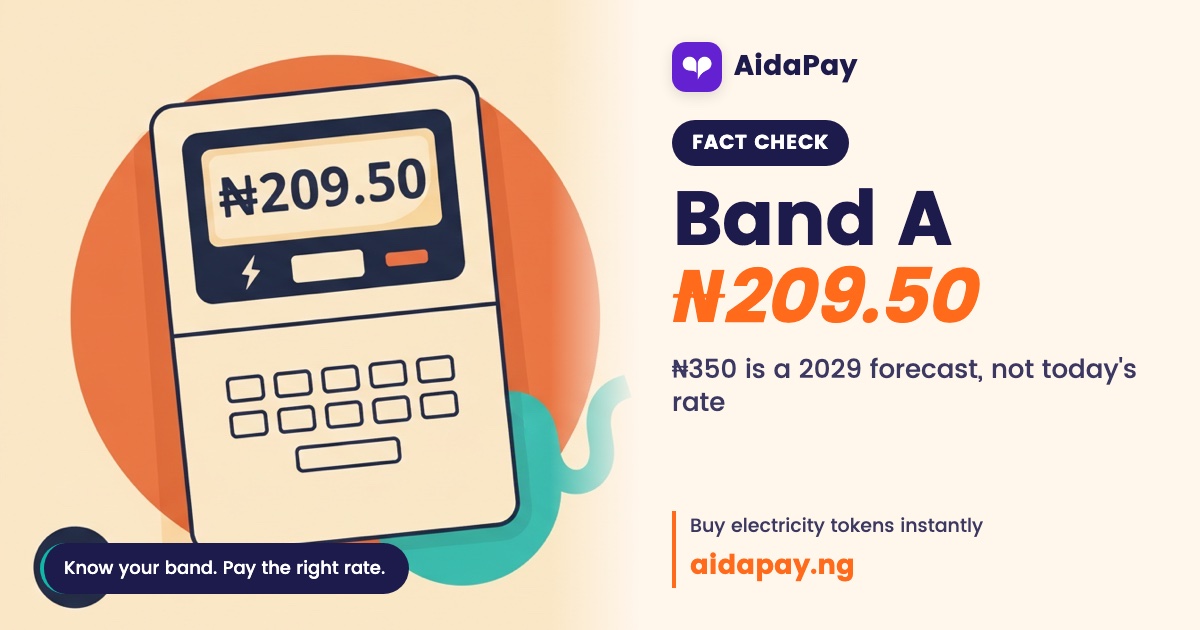
 Tariff Increase to ₦350/kWh? Band A Is Still ₦209.50
The ₦350 per unit warning is a 2029 forecast, not a NERC order. See what Band A and Band B pay today and how many units ₦10,000 wo...
Electricity
Electricity Tariff Increase to ₦350/kWh? Band A Is Still ₦209.50
The ₦350 per unit warning is a 2029 forecast, not a NERC order. See what Band A and Band B pay today and how many units ₦10,000 wo...
 Electricity
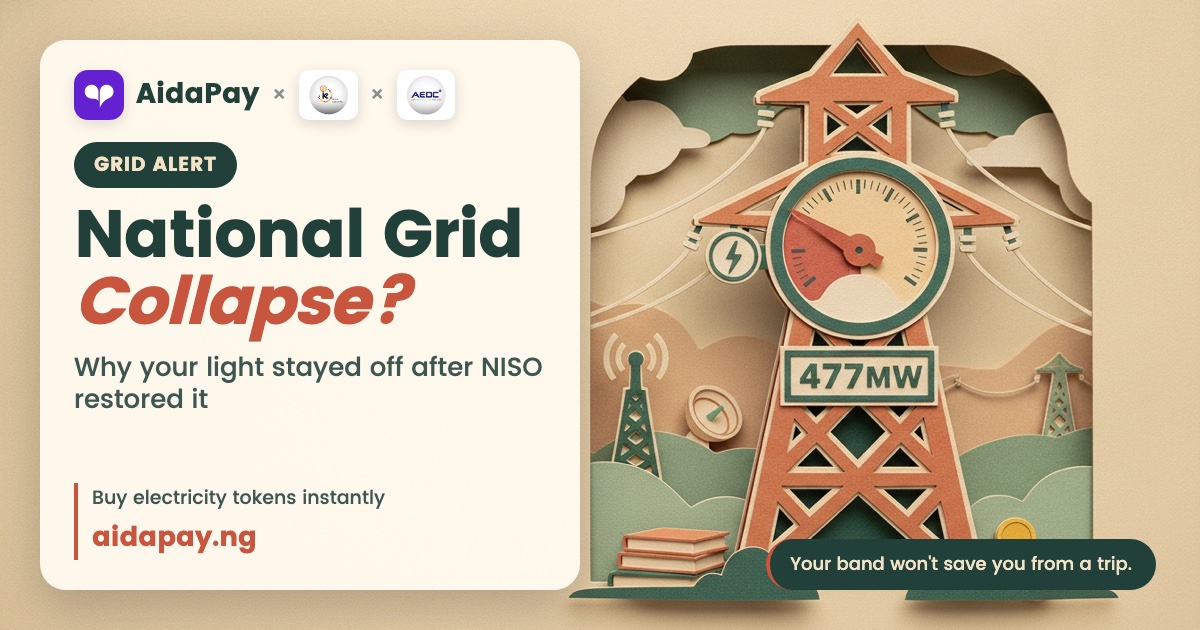
National Grid Collapse? The 477MW Trip and Why Your Light Is Off
Generation fell from 3,840MW to 476.70MW on 19 October 2026. NISO calls it a partial trip, not a collapse. Why streets stayed dark...
Electricity
National Grid Collapse? The 477MW Trip and Why Your Light Is Off
Generation fell from 3,840MW to 476.70MW on 19 October 2026. NISO calls it a partial trip, not a collapse. Why streets stayed dark...
 Electricity
Is Eko Power the Same as EKEDC? The LASERC Licence and Your Token
Your meter says EKEDC, but the news says Eko Power. Who holds the LASERC licence, whether your meter number changes, and where to...
Electricity
Is Eko Power the Same as EKEDC? The LASERC Licence and Your Token
Your meter says EKEDC, but the news says Eko Power. Who holds the LASERC licence, whether your meter number changes, and where to...